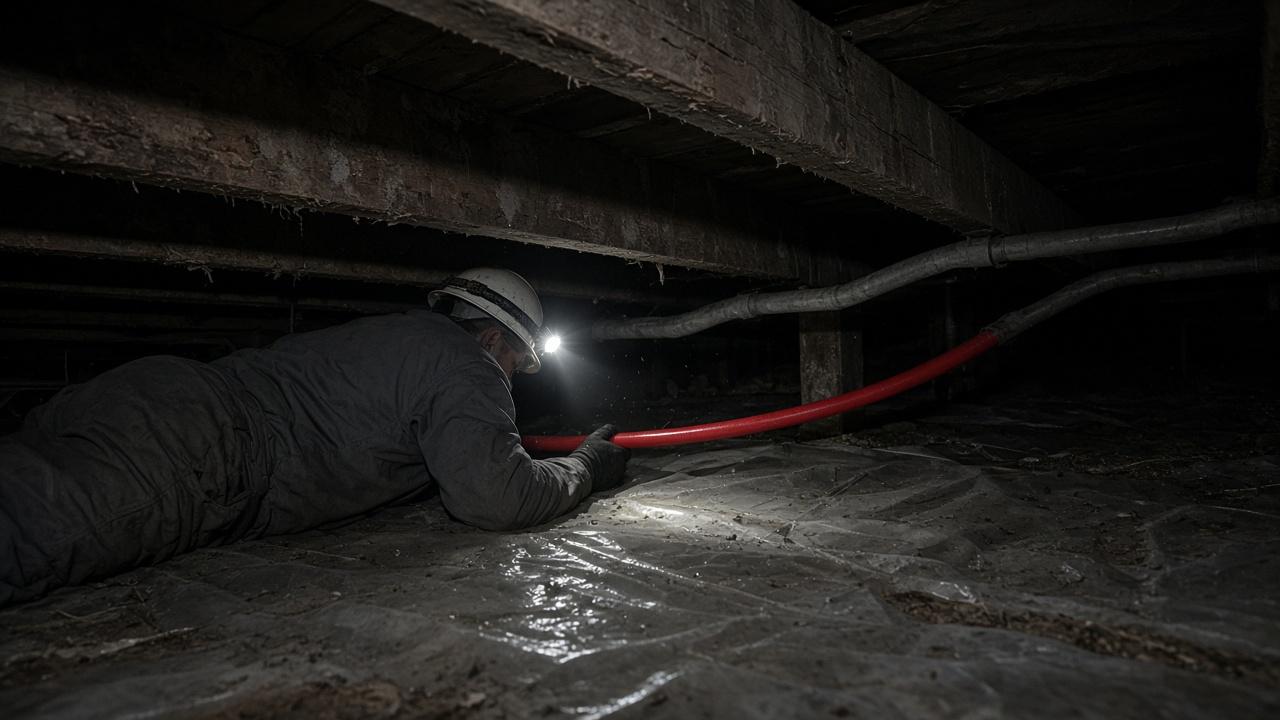
Crawl spaces are where Poly B deteriorates fastest. The combination of confined space, moisture, temperature swings, and limited air circulation creates conditions that accelerate the oxidation damage that chlorine starts. In most Coquitlam homes, the main cold-water supply and the hot water return lines run through the crawl space — making this the most critical area to address in any repipe.
Why Crawl Spaces Are the Highest-Risk Zone
Several factors combine to make crawl space Poly B more vulnerable than pipe inside conditioned walls. Temperature fluctuation is greater in a crawl space — even in BC's mild climate, sub-floor temperatures can drop below freezing during cold snaps. Poly B that has already experienced internal oxidation damage is especially susceptible to freeze-related expansion cracking.
Moisture is the second factor. Crawl spaces in older Coquitlam homes often have inadequate vapour barriers or no vapour barrier at all. Pipe in this environment is exposed to condensation, humidity, and in some cases groundwater intrusion. While Poly B doesn't corrode in the traditional sense, fittings and clamps in wet conditions can corrode, accelerating joint failure.
Third: visibility. Crawl space runs are not monitored. A slow failure in a crawl space can drip for weeks before anyone notices — and by then the subfloor, insulation, and sometimes the framing are compromised.
- Temperature extremes accelerate internal cracking in already-degraded Poly B
- Moisture and humidity stress fittings and clamps
- Failures in crawl spaces are not visible until water damage is already extensive
- Main supply runs almost always pass through the crawl space
- New vapour barrier recommended with every crawl space repipe
How We Work in Confined Spaces
Our crew is experienced in crawl space work. We carry appropriate protective equipment, lighting, and the right tools for working in low-clearance environments. Most Coquitlam crawl spaces are accessible enough to complete the work efficiently — we've worked in tight spaces across the Tri-Cities and know how to manage the access logistics.
PEX-A is particularly well-suited for crawl space installations. Its flexibility means we can often run long sections without additional support points, reducing the number of fittings in the crawl space and therefore the number of potential failure points.
We also recommend — and offer — a full vapour barrier installation during a crawl space repipe. Bringing a plumber into a crawl space twice is expensive and disruptive. Combining the repipe with a vapour barrier upgrade in one mobilization is efficient for you and gives the new PEX the best possible environment.
If you have Poly B in your crawl space, that's where we start. has the experience and equipment to complete the job properly in confined, difficult access areas. Book your free inspection and we'll assess the full scope.
Contact Coquitlam Poly B Replacement today to book your free inspection.
Questions About This Service
How do you access a crawl space — do you cut through the floor?
Most crawl spaces in Coquitlam have an exterior or interior access hatch. We use the existing access in almost all cases. Floor cuts are only required in rare situations where no access hatch exists and the only approach is through the subfloor.
Do you offer vapour barrier installation at the same time?
Yes. We coordinate vapour barrier installation during the repipe — same mobilization, less disruption.